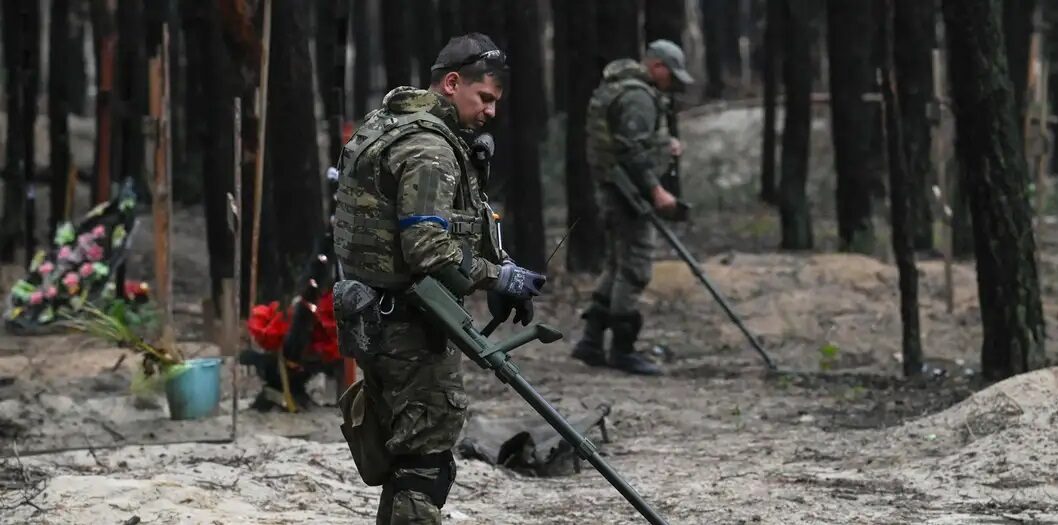

Drone warfare could leave Ukraine facing explosive contamination on a scale not seen since US cluster bombing along the Ho Chi Minh trail during the war in Vietnam, a UN mine action adviser told The Guardian.
The growing use of drone-delivered munitions by both Kyiv and Moscow is spreading unexploded ordnance across more territory, creating hazards that can kill and injure civilians for decades.
To make the costly and dangerous clearance work faster and safer, demining teams in Ukraine are testing remotely operated machines, survey drones, and AI tools to locate and remove explosives.
The HALO Trust, an international humanitarian organization that clears landmines and other explosives, spent nearly 50 million pounds ($66.3 million) last year clearing agricultural land of mines and unexploded ammunition.
Ukraine’s demining sector has received $1.5 billion since the full-scale invasion began in 2022, according to The Guardian.
Demining Efforts
The HALO Trust is testing the DMR-7, a remotely operated vehicle that uses compressed air to expose suspected explosives beneath the soil.
It can excavate a patch in about five minutes, compared with up to 45 minutes by hand, while its operator remains at a safe distance.
HALO is also testing ground-penetrating radar and sensors that detect explosive material.
Drones and satellite imagery help teams survey land for signs of explosives, with AI tools assisting image analysis.
Working Under Constant Threat
Demining teams face increasingly dangerous threats, including Russia’s POM-3, an antipersonnel mine triggered by ground vibrations from approaching footsteps.
Its cylindrical shape can resemble a discarded vacuum flask, making it difficult for civilians to identify.
A HALO unit commander said the threat had forced teams to avoid some villages entirely.
At the same time, those working elsewhere remain exposed to drone and missile strikes that sometimes directly target humanitarian personnel, according to The Guardian.
Efforts to survey land remotely face obstacles too. Electronic warfare systems used by both sides against military drones can disrupt humanitarian flights over suspected minefields.
HALO has lost several drones after their signals were jammed or their navigation systems were misled by false location data, a technique known as spoofing.