
The world’s oceans are becoming more contested, and nowhere is that more evident than in the Indo-Pacific. As regional navies expand their fleets and underwater threats multiply, Japan has responded with one of its most advanced conventional submarines yet: the Taigei class.
Quieter, smarter, and capable of staying submerged longer than its predecessors, these submarines represent the next step in Japan’s undersea deterrence strategy.
Here’s everything you need to know about the Taigei-class submarine and why it’s attracting attention beyond Japan’s shores.
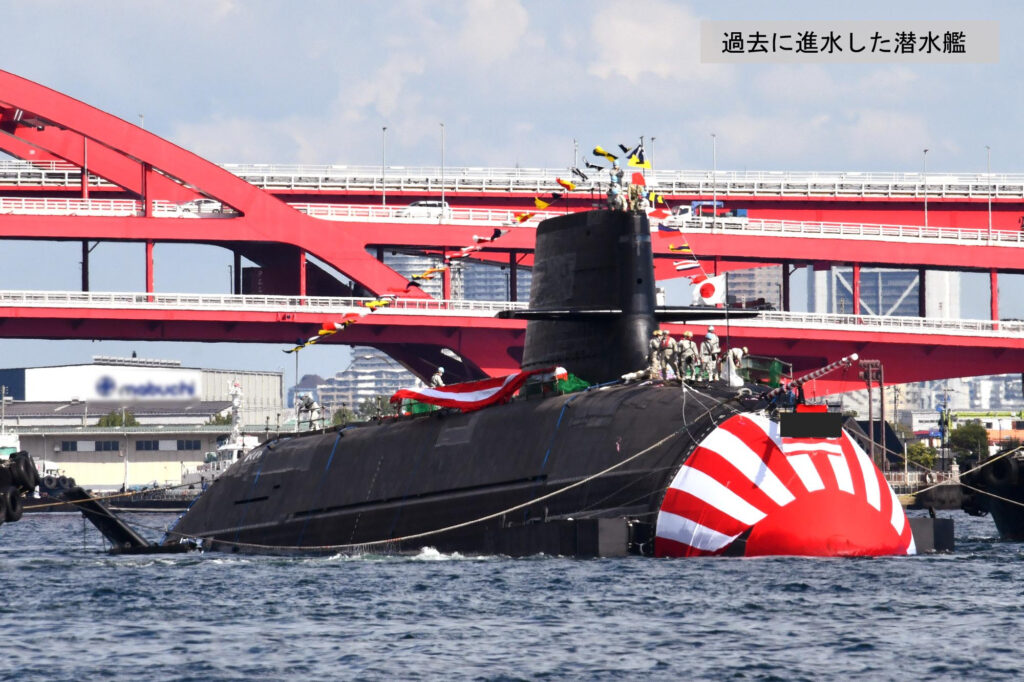
At a Glance
| Category: | Details: |
| Type | Diesel-electric attack submarine |
| Role | Anti-submarine warfare, anti-surface warfare, maritime surveillance and intelligence gathering, sea denial and deterrence, and special operations support |
| Manufacturer | Mitsubishi Heavy Industries and Kawasaki Heavy Industries |
| Operator | Japan Maritime Self-Defense Force |
| Crew | Approximately 70 |
| Displacement | About 3,000 tons |
| Length | 84 meters (276 feet) |
| Beam | 9.1 meters (29.1 feet) |
| Draft | 10.4 meters (34.1 feet) |
| Propulsion | Diesel-electric, single shaft, lithium-ion batteries |
| Speed | Submerged: >20 knots (23 miles/37 kilometers per hour) |
| Armament | 6 x 533-mm torpedo tubes capable of launching torpedoes and anti-ship missiles |
What Is the Taigei-Class Submarine?
The Taigei-class submarine is the Japan Maritime Self-Defense Force’s (JMSDF) newest generation of diesel-electric attack submarines, developed to replace the highly regarded Soryu class.
While retaining the stealth and versatility expected of modern conventional submarines, the class introduces quieter propulsion, more capable sonar and combat systems, and lithium-ion batteries that significantly improve underwater endurance.
Although conventionally powered, the Taigei class can remain submerged for extended periods thanks to its advanced battery technology, reducing the need to snorkel and lowering the risk of detection compared to earlier diesel-electric designs.
The class forms a key pillar of Japan’s submarine fleet and, in essence, its maritime defense strategy, protecting sea lines of communication, conducting anti-submarine warfare, and supporting intelligence gathering in the East China Sea and western Pacific.
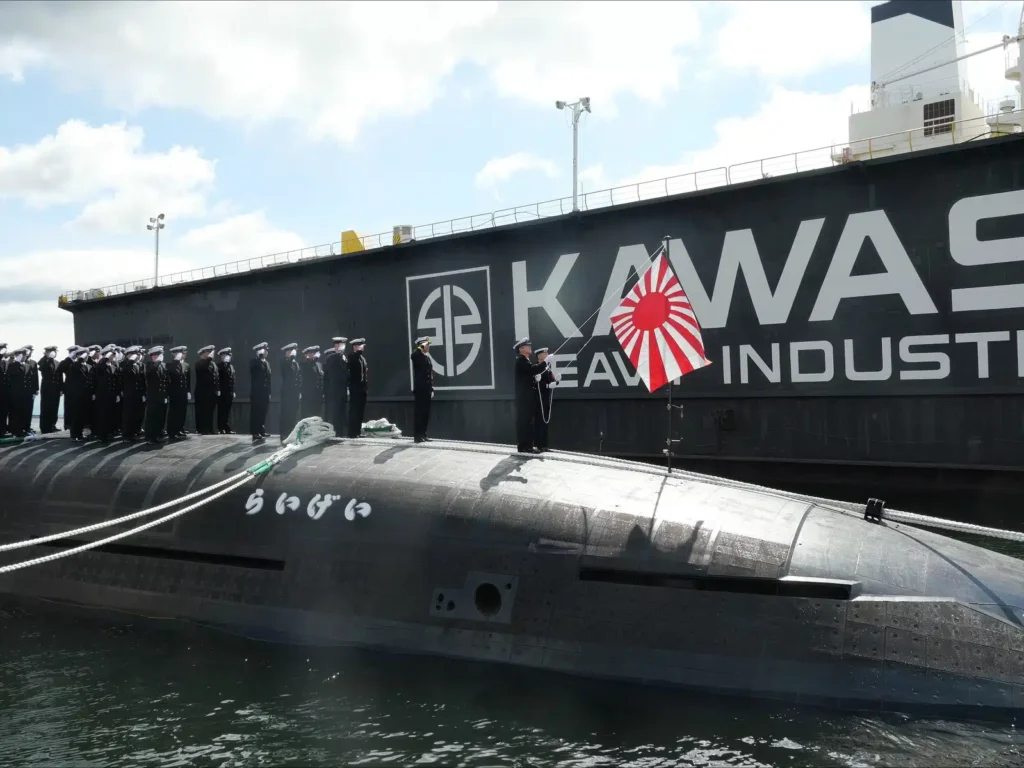
How the Taigei Class Came to Be
Japan’s pursuit of the Taigei class reflects a broader effort to modernize its conventional submarine force through advances in energy storage and underwater performance.
Development traces its roots to the Soryu class, which initially relied on air-independent propulsion (AIP) to extend submerged operations without surfacing.
As lithium-ion battery technology matured, however, the JMSDF concluded that it could offer greater operational flexibility than AIP by enabling higher sustained speeds, faster recharging, and simpler maintenance.
The final two Soryu-class submarines became the first Japanese boats to adopt the new battery system, providing valuable operational experience before it was incorporated into the next generation.
Those lessons shaped the Taigei class, which was designed from the outset around large-capacity lithium-ion batteries instead of traditional AIP.
Construction of the lead boat, JS Taigei, began in 2018, with Mitsubishi Heavy Industries and Kawasaki Heavy Industries sharing production responsibilities.
After entering service in 2022, JS Taigei was redesignated as a test submarine in 2024 to support the evaluation of future undersea technologies, while additional boats continue to expand the JMSDF’s next-generation submarine fleet.
Taigei-Class Variants
The Taigei family currently consists of production submarines rather than specialized mission variants.
Commissioned and planned boats include:
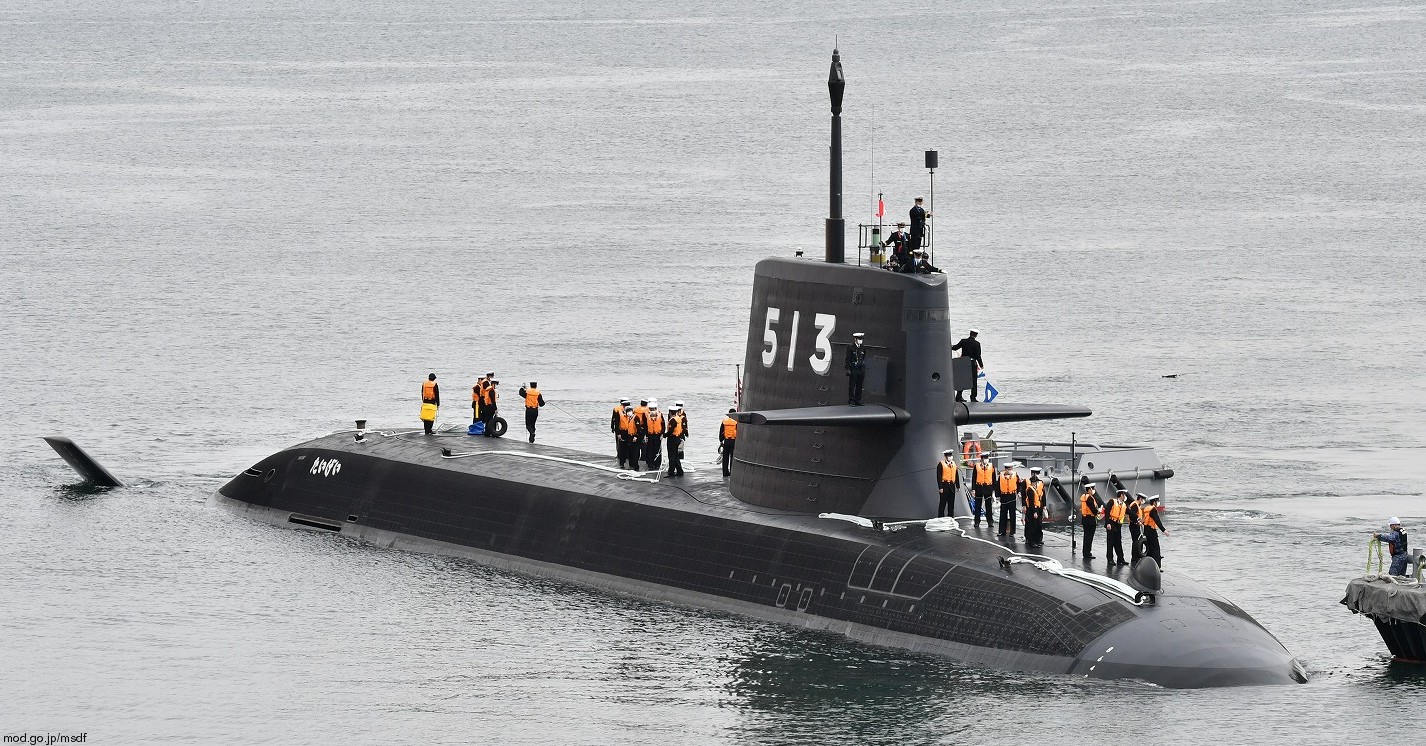
- JS Taigei (SS-513): Lead ship; entered service in 2022 and redesignated SSE-6201 as a test submarine in 2024 to support the evaluation of future undersea technologies.
- JS Hakugei (SS-514)
- JS Jingei (SS-515)
- JS Raigei (SS-516)
- JS Chogei (SS-517)
Additional boats are under construction or approved as Japan continues expanding the class.
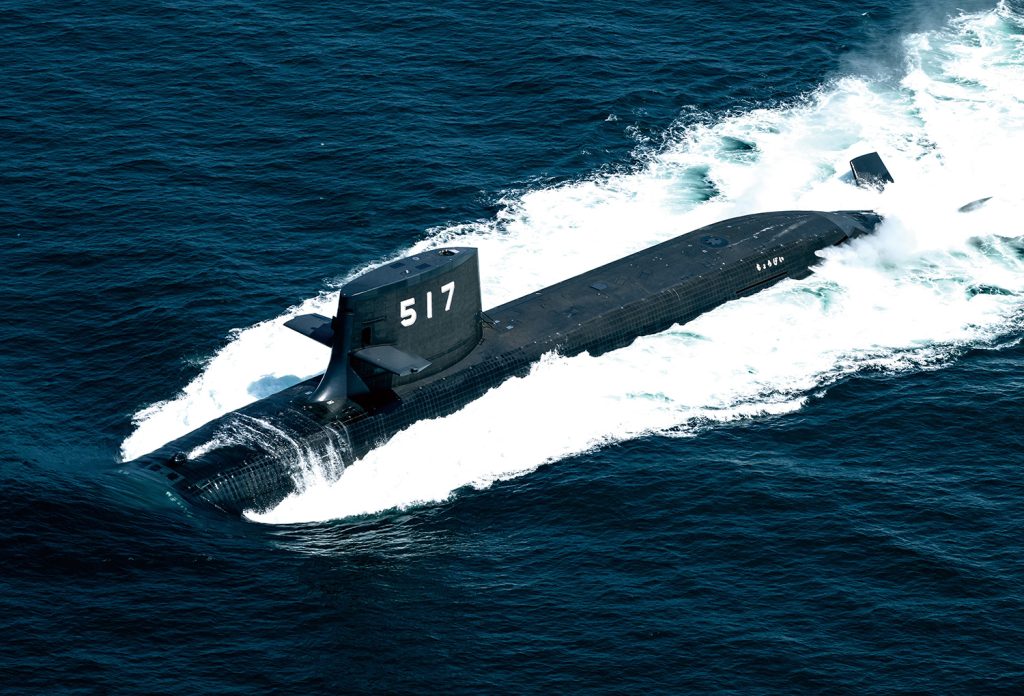
How Does the Taigei-Class Submarine Work?
The Taigei combines stealth, endurance, and advanced sensors to detect and engage enemy vessels while remaining difficult to find.
Key Features
Lithium-Ion Battery Propulsion
Perhaps the submarine’s biggest innovation is its large lithium-ion battery system.
Compared with conventional lead-acid batteries, lithium-ion batteries recharge faster, store more energy, and allow the submarine to remain submerged longer while operating more quietly. Unlike AIP-equipped submarines, the Taigei can sustain higher underwater speeds without relying on separate propulsion modules.
Advanced Sonar and Combat System
The class features an upgraded sonar suite with bow-mounted, flank-array, and fiber-optic towed-array sensors that improve long-range target detection.
A new combat management system rapidly processes sensor information, enabling crews to track multiple contacts and coordinate weapons more effectively.
Improved Stealth
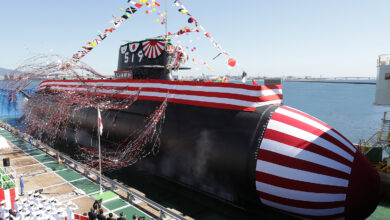
The Taigei incorporates a redesigned hull, enhanced sound insulation, floating deck structures, and improved acoustic materials to reduce noise.
Its distinctive X-shaped stern control surfaces also improve maneuverability, particularly in shallow coastal waters where Japan expects many future submarine operations to occur.
_left_side_view_in_Port_of_Kobe_March_9,_2022.jpg)
Strengths
The Taigei class offers several advantages over earlier Japanese submarines:
- Longer submerged endurance through lithium-ion batteries
- Improved underwater stealth
- More capable sonar and combat systems
- Better maneuverability with X-rudder configuration
- Enhanced automation that reduces crew workload
- Accommodations designed to support mixed-gender crews, including dedicated facilities for female sailors
Limitations
Despite its advanced design, the Taigei class has some constraints.
- Not nuclear-powered: Unlike US, British, or French attack submarines, the Taigei must periodically surface or snorkel to recharge its batteries using diesel generators. Although lithium-ion technology extends underwater endurance, it cannot match the virtually unlimited submerged endurance of nuclear-powered submarines.
- Higher procurement costs: The sophisticated battery system, upgraded sensors, and new propulsion technologies make the Taigei significantly more expensive than many conventional submarines, with each boat costing roughly 70 billion yen ($444 million).
- Limited export potential: Japan has relaxed restrictions on defense exports in recent years, but the Taigei has not been offered widely overseas. Sensitive technologies, particularly their battery systems and acoustic quieting measures, are likely to remain closely guarded.
_launching_ceremony_at_Kawasaki_Heavy_Industries_Kobe_Shipyard_October_14,_2021_04.jpg)
Global Use
The Taigei class currently serves exclusively with the Japan Maritime Self-Defense Force. Its primary missions include anti-submarine warfare, anti-surface warfare, maritime surveillance, intelligence gathering, protection of Japan’s sea lines of communication, and deterrence patrols in the East China Sea, Philippine Sea, and broader Indo-Pacific
Although the class has not been exported, its adoption of lithium-ion batteries has influenced submarine designers worldwide, with several navies closely monitoring Japan’s experience with the technology.
Future Outlook
The Taigei class represents one of the most capable conventionally powered submarines ever built, but it is also a bridge to Japan’s next generation of undersea warfare.
Lessons learned from its advanced battery technology, quieter hull, and digital combat systems are expected to shape future Japanese submarine designs.
As China continues to expand its naval presence and undersea competition intensifies across the Indo-Pacific, the Taigei class is likely to become the backbone of Japan’s submarine force for decades.
While nuclear-powered submarines still offer unmatched endurance, the Taigei demonstrates that advances in conventional propulsion can narrow the capability gap, making it one of the most formidable diesel-electric submarines operating today.