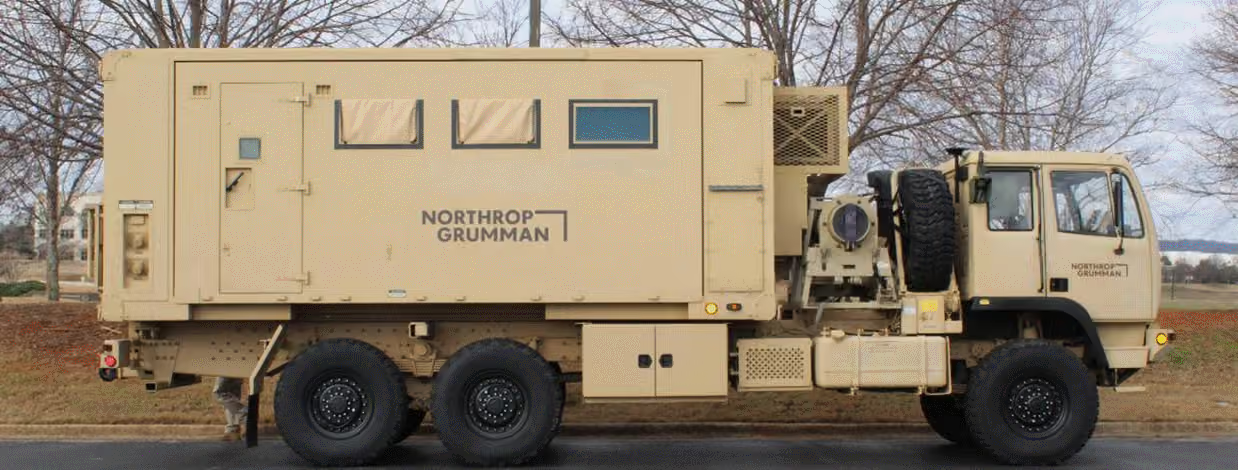

The US Army has awarded Northrop Grumman a $21-million contract to deliver two prototypes of a more survivable, mobile workspace for its Integrated Battle Command System (IBCS).
The new configuration will replace the current tent-based IBCS Integrated Collaborative Environment (ICE) with an expandable shelter mounted on a protected vehicle.
ICE is one of three IBCS components, alongside the Engagement Operations Center and the Integrated Fire Control Network Relay. It provides a workspace for personnel involved in air and missile defense planning and operations.
In its current fielded configuration, ICE uses a deployable air-beam tent with operator workstations, supported by environmental-control and power equipment. The new design features sides that extend outward, providing additional space for soldiers, equipment, and mission systems.
The vehicle-mounted configuration is designed to help IBCS adapt quickly to evolving mission requirements and changing environments while improving survivability and reducing setup and teardown times. It supports six operator workstations and four staff operation stations, maximizing combat power within a more agile footprint.
“Our sustained investments in innovation are turning IBCS into an ever-more capable combat multiplier for the warfighter,” Northrop Grumman’s vice president and general manager of command and control and weapons integration Kenn Todorov said.
“By boosting the Integrated Collaborative Environment’s survivability and mobility, we’re giving warfighters greater protection and faster access to advanced command and control technology as they face increasingly complex and dynamic battlespaces.”
Integrated Battle Command System
The IBCS connects sensors, weapons, and command-and-control systems across services and domains, fusing their data into a single, actionable picture of the battlespace.
Its open, modular architecture enables rapid threat assessment and an “any sensor, best shooter” approach, allowing operators to select the most suitable weapon to counter threats ranging from drones to hypersonic missiles.
IBCS is in full-rate production and operational in Poland as part of the US Army’s integrated air and missile defense modernization program. Over the next decade, it is expected to replace legacy air-and-missile defense command-and-control systems, including those supporting Patriot, THAAD, and the Forward Area Air Defense system.