Cluster munitions killed or injured at least 1,063 people worldwide last year, the third-highest annual toll on record, with civilians, including children, accounting for 87 percent of the recorded casualties, according to a new report by the Cluster Munition Coalition’s research network.
Across all affected countries, 946 people were killed or injured in cluster munition attacks, while another 117 became casualties of unexploded remnants.
The report cautioned that the actual toll is probably higher because many casualties go unreported.
New casualties were documented in Afghanistan, Cambodia, Iraq, Laos, Lebanon, Myanmar, Russia, Syria, and Ukraine.
Cluster munitions disperse smaller explosives, known as submunitions or bomblets, across a wide area.
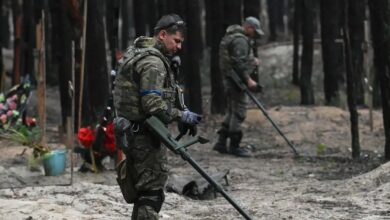
Those that fail to detonate can remain dangerous long after fighting has ended.

Ukraine Records Highest Toll
Ukraine recorded at least 927 casualties last year, the highest total of any country for the fourth consecutive year.
Both Russia and Ukraine continued using the weapons as neither country is a party to the Convention on Cluster Munitions.
Moscow maintained that cluster munitions are lawful and argued that civilian harm resulted from improper use.
Ukraine’s military said it follows international humanitarian law when employing the weapons.
Investigators also found that North Korean-made cluster munitions were used by Russian forces in Ukraine in 2025.
Continued Use and Production
The report also documented cluster munitions used by Myanmar within its own territory, by Iran against Israel, and by Thailand during its border conflict with Cambodia.
They were also used in Mali, although the responsible party has not been identified.
Other allegations included the use of cluster munitions by Pakistan in Afghanistan, by the US or Israel in Iran, by Houthi forces against Israel, and by Israel in Lebanon.
Investigators found evidence of new production in China, India, Israel, Myanmar, North Korea, Poland, Romania, Russia, and South Korea.
In total, 18 countries continued to produce cluster munitions or reserve the right to do so.
According to the report, Israel was contracted in September last year to manufacture and transfer cluster munitions to the US.

Progress and Funding Cuts
The 2008 Convention on Cluster Munitions has 112 state parties and 12 signatories.
No member has been confirmed to have used, produced, or transferred the weapons since joining, although Lithuania became the first country to withdraw in 2025.
Forty-two members have destroyed their declared stockpiles, eliminating 1.49 million cluster munitions and 179 million submunitions.
Contaminated land released for civilian use increased by 15 percent in 2025, but 29 countries and territories remain affected by unexploded remnants.
About $116 million funded clearance and related work.
However, US aid cuts disrupted operations in Southeast Asia and reduced mine-action capacity in Afghanistan, Iraq, and South Sudan.
They also forced a major victim-assistance project in Laos to close.
More than 50 years after the bombing ended, Laos remains the world’s most cluster munition-affected country.