The MQ-9 Reaper has become one of the world’s most recognizable drones, serving as a long-endurance platform for intelligence, surveillance, and reconnaissance (ISR) as well as strike missions.
As military requirements evolved, however, manufacturers sought to adapt the Reaper’s proven design for new operational environments. The result was the MQ-9B family, which includes the SkyGuardian and SeaGuardian variants.
While all three aircraft share a common heritage, each is optimized for different mission sets and operating requirements.

The Foundation: MQ-9 Reaper
The MQ-9 Reaper was developed by General Atomics Aeronautical Systems primarily for ISR and armed strike missions. Powered by a turboprop engine, the Reaper can remain airborne for more than 24 hours while carrying sensors, guided bombs, and air-to-ground missiles.
It has been widely used by the United States and allied nations in counterterrorism, reconnaissance, and precision-strike operations.
Key Features
- Long-endurance ISR and strike capability
- Ability to carry weapons such as Hellfire missiles and guided bombs
- Satellite communications for beyond-line-of-sight operations
- Proven operational record in combat environments
MQ-9B SkyGuardian
The MQ-9B SkyGuardian was developed as the next-generation version of the Reaper, designed to meet stricter international airworthiness and civil airspace requirements.
Unlike the original Reaper, the SkyGuardian incorporates enhanced safety systems that allow it to operate more easily in civilian-controlled airspace. It also features improved endurance and upgraded communications systems.
Key Features
- Endurance of more than 40 hours
- Detect-and-avoid system for integration into civilian airspace
- Automatic takeoff and landing capability
- Enhanced cybersecurity and communications architecture
- Multi-domain ISR capability
- Resilience against extreme weather
The SkyGuardian is intended for a broad range of missions, including border security, intelligence gathering, disaster response, and military surveillance.

MQ-9B SeaGuardian
The MQ-9B SeaGuardian is a maritime-focused derivative of the SkyGuardian.
While it retains most of the SkyGuardian’s airframe and systems, SeaGuardian adds specialized sensors and mission equipment optimized for naval operations and maritime domain awareness.
Key Features
- Maritime surveillance radar
- Automatic Identification System tracking
- Surface-search and vessel-monitoring capabilities
- Anti-submarine warfare integration options
- Long-range ocean surveillance missions
- Improved all-weather surveillance capabilities
These enhancements allow SeaGuardian to monitor shipping lanes, detect suspicious vessels, support naval task groups, and conduct maritime ISR missions over vast areas.

Similarities and Differences
| Feature | MQ-9 Reaper | MQ-9B SkyGuardian | MQ-9B SeaGuardian |
| Endurance | 24+ hours | 40+ hours | 40+ hours |
| Civil Airspace Integration | Limited | Yes | Yes |
| Strike Capability | Yes | Configurable | Configurable |
| Maritime Surveillance | Limited | Limited | Optimized |
| Detect-and-Avoid System | No | Yes | Yes |
| Primary Mission | ISR and strike | Multi-role ISR | Maritime ISR |
Global Operators
The MQ-9B family has attracted a growing list of operators, particularly among NATO allies prioritizing long-endurance ISR without the airspace restrictions that limit the original Reaper.
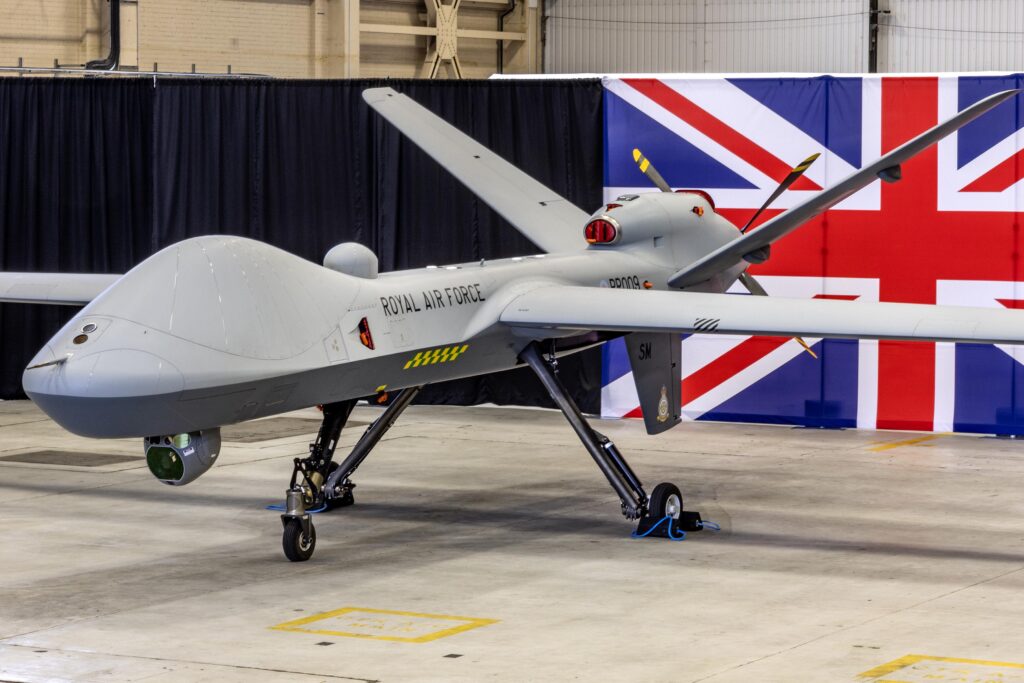
The UK’s Protector RG Mk1 program is the most significant SkyGuardian procurement to date. The Royal Air Force ordered 16 aircraft as a direct Reaper replacement, with the Protector being the armed variant of the SkyGuardian — the first MQ-9B configured for weapons delivery.
The program has faced delays but represents the clearest example of how the SkyGuardian bridges the gap between the original Reaper’s combat focus and the need for civilian airspace integration.
Belgium ordered four MQ-9B SkyGuardians, with the first system delivered in the summer of 2025, configured as a reconnaissance asset without weapons.
Canada signed a $2.49 billion Canadian dollar contract in December 2023 for 11 MQ-9Bs, including Hellfire missiles and ground control stations, though deliveries are not expected until 2028 and full operational capability is likely by 2033.
Denmark procured four MQ-9B SkyGuardians through the NATO Support and Procurement Agency in July 2025, focused on surveillance of the Baltic Sea, Arctic, and North Atlantic, with deliveries scheduled for 202 and 2029. Norway is also examining the platform for long-range maritime surveillance in the high north.
On the maritime side, Japan’s Coast Guard signed an agreement in August 2024 to acquire two SeaGuardians, while the Indian Navy has two SeaGuardians on lease with 15 more on order. Taiwan has also purchased SkyGuardians as part of broader US arms sales.
Choosing the Right Platform: SkyGuardian, SeaGuardian, or Reaper?
The answer depends entirely on the mission.
The MQ-9 Reaper remains the platform of choice for military operators prioritizing armed strike and combat-proven ISR in permissive or semi-permissive environments — its weapons integration and operational record are unmatched within the family.
The SkyGuardian is the right choice where airspace integration matters: border security agencies, coalition partners operating in civilian-controlled airspace, or militaries planning to deploy across national boundaries without triggering airspace restrictions.
The SeaGuardian addresses a different problem entirely: persistent maritime domain awareness over vast ocean areas where no other platform in the family can operate as effectively. For naval forces monitoring shipping lanes, tracking vessels of interest, or supporting anti-submarine operations, no other variant comes close.
In short, the three platforms are not competitors. They are purpose-built answers to three distinct operational questions, and the right choice is whichever one matches the threat environment the operator actually faces.