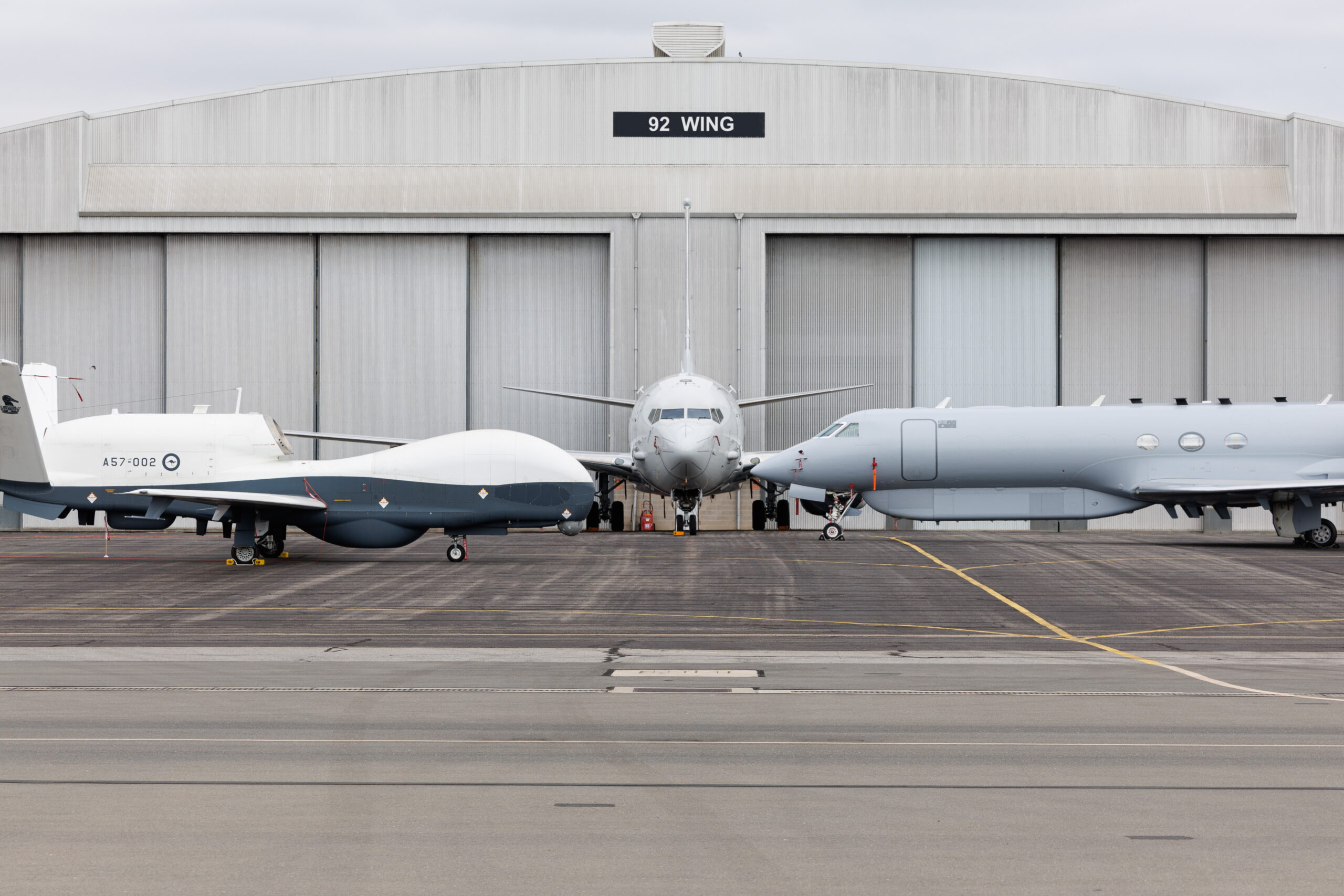
Australia Reaches Key ISR Milestones Across Triton, Peregrine, and Poseidon Fleets


The Royal Australian Air Force (RAAF) has declared initial operational capability for its MQ-4C Triton unmanned aerial systems and MC-55A Peregrine jets, alongside the completion and upgrade of the military’s P-8A Poseidon multi-mission fleet.
Announced by Defence Minister Richard Marles and Chief of Air Force Air Marshal Stephen Chappell, the updates follow extensive operational testing that prepared the new assets for acceptance into service.
The milestones align with Canberra’s latest National Defence Strategy, which covers approximately 5.5 billion Australian dollars ($3.8 billion) in investments over the next decade to enhance its air intelligence, surveillance, reconnaissance, and electronic warfare capabilities.
Tritons Supporting Regional Scouting
Supported by Northrop Grumman Australia, four high-altitude, long-endurance MQ-4Cs will be stationed at RAAF Base Tindal, Northern Territory, and operated remotely by No. 9 Squadron at RAAF Base Edinburgh, South Australia.
The autonomous platforms will deploy for long-range scouting missions across the Indo-Pacific, allowing crewed systems to focus on specific missions.
Peregrines for Signals Missions
Simultaneously, a separate team of controllers from the No. 10 Squadron at Edinburgh will handle the MC-55As.
Converted from Gulfstream G550 airframes, three of the four Peregrines ordered under a 2019 contract have been delivered to provide specialized airborne signals intelligence and electromagnetic countermeasures support.
The final aircraft under that initiative is scheduled to arrive later this year.
Poseidons in Patrol, Multi-Domain Warfare
The handover of the final P-8A caps off RAAF’s 14-aircraft fleet planned in 2021. It also coincided with the arrival of the first of two Poseidons under the series outfitted with improved sensors, flight systems, and software.
Upgrades for the remaining 12 P-8As will take place domestically at Edinburgh in partnership with Boeing Defence Australia and the local industry network.
The planes’ primary tasks include maritime patrol as well as anti-submarine and anti-surface warfare.
“Our people have been at the heart of delivering the air intelligence, surveillance and reconnaissance capability for Australia, demonstrating exceptional skill, professionalism and dedication in bringing these complex systems into service,” Chappell stated.
“The achievements announced today mark a significant step forward in Air Force capability…that strengthens our ability to protect Australia’s interests and deliver highly effective air power as part of the integrated, focused force.”