The French defense procurement agency has awarded Safran Electronics & Defense and MBDA a contract to deliver their Thundart long-range land-strike system.
Selected among several domestic contenders, the system will replace France’s Unitary Rocket Launcher (LRU), a version of the M270 Multiple Launch Rocket System. Around nine LRUs are currently operational and are scheduled to be replaced with Thundart by 2030.
To manage the program, Safran and MBDA will establish a joint venture in Paris in January 2027. The venture will support the development, production, and in-service support of Thundart, as well as its future adaptation for other environments and allied export markets.
“Faced with the critical challenges of jamming and access denial of GNSS signals, Safran Electronics & Defense brings its proven leadership in inertial navigation and optronics technologies to guarantee accuracy in all circumstances,” Director of the Global Business Unit for Defense at Safran Electronics & Defense Alexandre Ziegler said.
“By leveraging mature subsystems and an already established industrial ramp-up, we are able to respond with agility to the Army’s needs,” Executive Vice President of Programs and Managing Director of MBDA in France Stéphane Reb said.
“This close partnership with Safran Electronics & Defense, formalized by the creation of a joint venture, allows us to mobilize all the skills of our teams and our production capabilities to deliver a complete solution within optimized timeframes,” he added.
Thundart
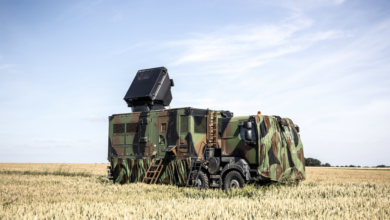
Thundart is designed to extend France’s long-range strike capability to 150 kilometers (93 miles), while offering greater firepower and saturation capability, cross-country mobility, and improved survivability in contested environments. In comparison, the existing LRU has an operational range of around 80 kilometers (50 miles).
The system uses hybrid Inertial Navigation System/Global Navigation Satellite System (INS/GNSS) guidance with resilient positioning, allowing it to engage static and moving targets in jammed or GNSS-denied conditions.
Its launcher carries two pods of four guided rockets and supports rapid “shoot-and-scoot” operations. Thundart is also designed to integrate with existing C3I (Command, Control, Communications, and Intelligence), including the French Army’s ATLAS fire-control system.