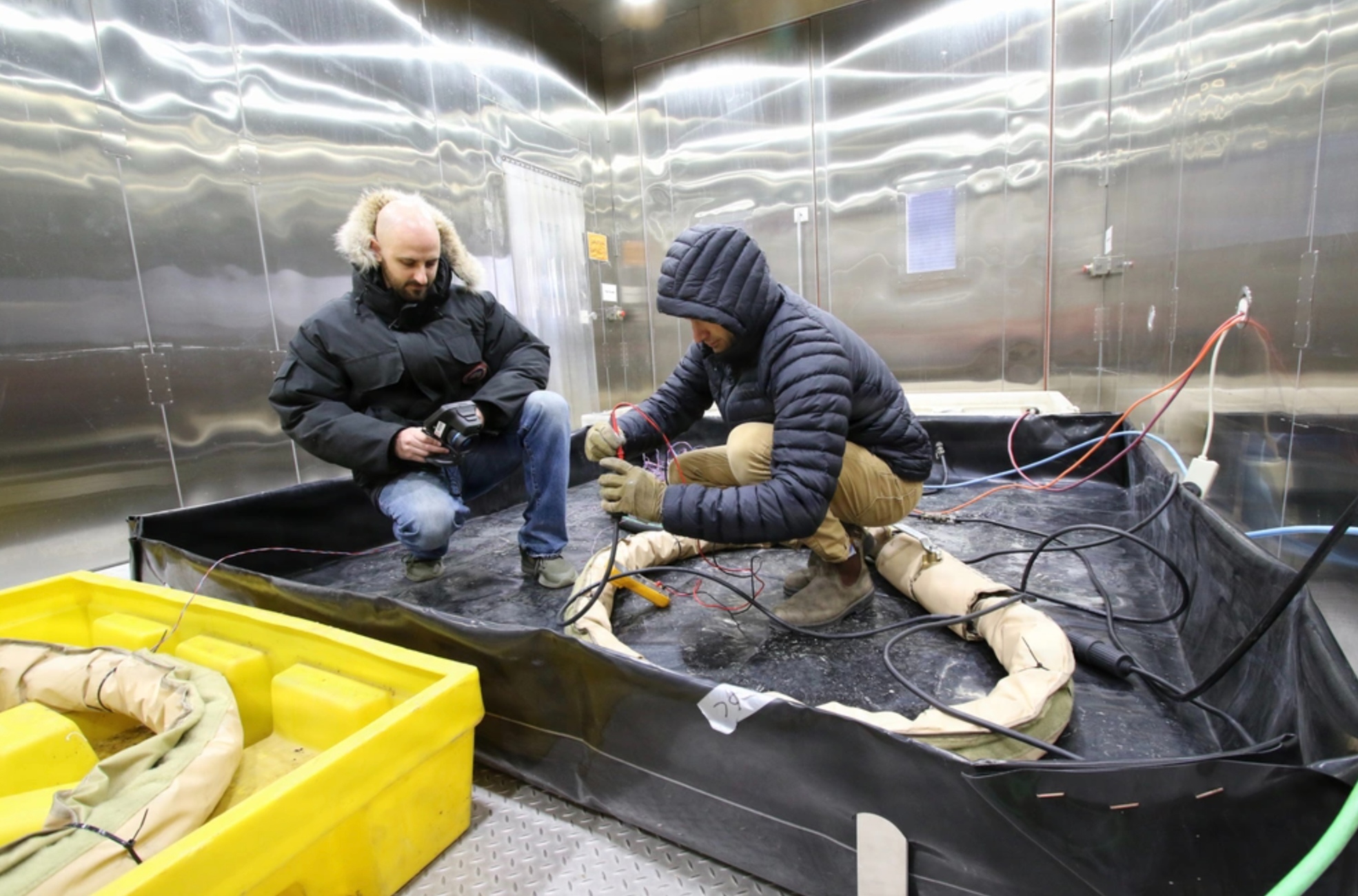

US military researchers have tested expeditionary base camp systems at temperatures as low as -65 degrees Fahrenheit (-54 degrees Celsius) to keep essential facilities operational in Arctic conditions.
Researchers from the US Navy’s Naval Facilities Engineering and Expeditionary Warfare Center and the US Army’s Cold Regions Research and Engineering Laboratory (CRREL) worked on improving rapidly deployable triple container-based systems used to provide kitchens, showers, laundries, and latrines at forward bases.
The systems currently in use can operate at temperatures down to about -15 degrees Fahrenheit (-26 degrees Celsius), but the military wants them to function at -50 degrees Fahrenheit (-45 degrees Celsius) under its Arctic strategy.
Researchers focused on components vulnerable to freezing and cracking, including hoses, valves, bladders, and pumps. They tested different combinations of thermal wrapping, insulation, and other components while monitoring temperatures in real time.
Testing took place inside CRREL’s Extreme Cold Chamber in Hanover, New Hampshire, which can reach temperatures as low as -90 degrees Fahrenheit (-68 degrees Celsius). The controlled environment allows researchers to recreate extreme conditions without exposing personnel or equipment to the risks of field testing.
Keeping these facilities operational could allow US forces to establish and maintain base camps in colder locations and for longer periods.
“Our armed forces live and operate in extremely cold and difficult conditions, so having these facilities operational is important for their physical and mental health while serving in the Arctic and other high-north environments,” CRREL research chemist Dan Tague said.
US Expands Arctic Operations
The US military is increasing its focus on operating in the Arctic, where extreme cold can affect troops, equipment, mobility, and basic infrastructure.
The Pentagon’s 2024 Arctic strategy calls for more exercises with allies and investment in capabilities needed to operate in the region.
In May, the US Marine Corps established a new rotational force for Alaska as part of its broader Arctic expansion. The force will train and operate in extreme cold, austere terrain, and areas with limited infrastructure.
In January, the US Army’s 11th Airborne Division advanced efforts to adapt drones for Arctic operations by establishing dedicated manufacturing and training facilities at bases in Alaska.
Earlier, in January, more than 450 US soldiers and airmen took part in the winter iteration of Northern Strike 26 in Michigan, training in subzero temperatures while testing weapons, vehicles, utilities, and other equipment.