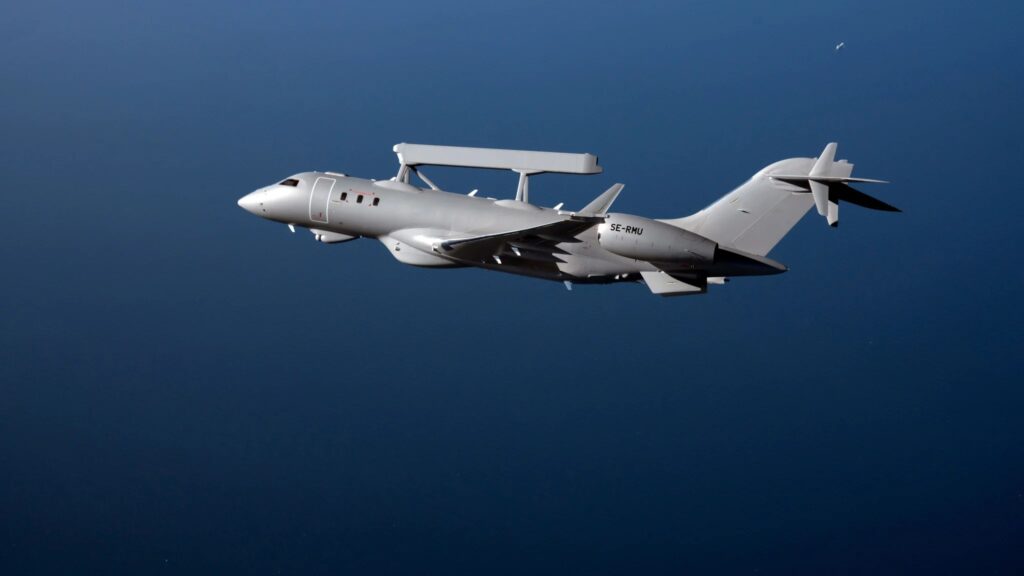
Canada has selected Sweden’s Saab GlobalEye as its next airborne early warning and control aircraft before establishing whether the platform meets military needs, according to defense sources.
Prime Minister Mark Carney announced the plan in May for six surveillance planes, committing to the deal without the Royal Canadian Air Force finalizing its operational requirement input.
The decision surprised top military leaders, including the air force commander, insiders told CBC.
Subsequent RCAF assessments revealed the current GlobalEye model fulfills only a portion of the military’s metrics.
Evaluations exposed a lack of 360-degree radar coverage, missing in-flight refueling capabilities, limited crew stations, and insufficient connectivity equipment required for integration into the US-Canadian NORAD network.
Ottawa’s Defence Investment Agency defended the choice, stating the GlobalEye is a proven aircraft and the “best choice” that minimizes developmental risk.
Meanwhile, Secretary of State for Defence Procurement Stephen Fuhr emphasized that economic factors, local production lines, and geopolitics must balance strict military demands.
“Are the requirements important? Of course they are,” Fuhr said. “It’s not the only thing that needs to be considered here. There’s gonna be trade-offs everywhere.”
‘Strange Lengths’
Saab has already expressed flexibility to adapt the aircraft to the North American country’s demands, offering to integrate additional nose and tail radars alongside an aerial replenishment function.
However, defense analysts and former procurement officials warn that bypassing standard procurement processes risks significant delays, cost overruns, and operational gaps that mirror past acquisition stumbles similar to the troubled CH-148 Cyclone helicopter program.
“You don’t have to go to these strange lengths in order to try to do things faster,” said Alan William, a former materiel assistant deputy minister for the Canadian Department of Defence.
“I think it really does undermine the process. And it makes us look, I think, very, very amateurish.”