Voyager Technologies has received a $22.4 million research and development contract from the Pentagon’s Strategic Capabilities Office to develop satellite deployment systems that make use of spare capacity on space launches.
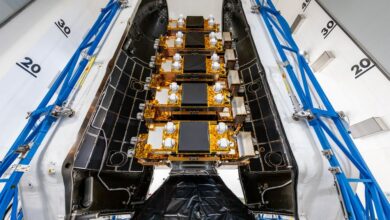
The company will build flight-ready prototype dispensers, devices that hold small satellites during launch and release them once the launch vehicle reaches space.
These systems would allow additional satellites to travel alongside a launch’s main payload.
The project focuses on launches that have room to carry more spacecraft than their primary mission requires.
Designed to carry small satellites with separate missions, the dispensers would operate without interfering with the main payload or its mission requirements.
This approach could give additional spacecraft a route to orbit aboard an existing launch.
The aim is to carry more satellites on each launch without interfering with its primary mission.
Ultimately, the technology is intended for use by the US Space Force.
Recent Defense Projects
The satellite dispenser award follows other Voyager agreements involving weapons propulsion, spacecraft communications, and AI for military operations.
Earlier this month, Anduril Industries and Voyager established a partnership covering propulsion and other technologies for US weapons and missile defense programs.
The collaboration spans development, testing, qualification, and production as programs move toward higher manufacturing rates.
In August, Raytheon awarded Voyager a contract supporting the Standard Missile-3 interceptor family.
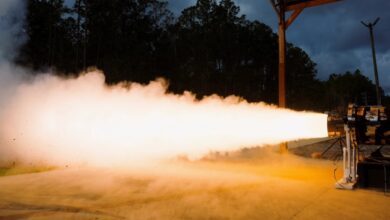
Under the initiative, Voyager will provide controllable solid-propellant propulsion technology and divert and attitude control systems, which help steer and stabilize the interceptor’s kinetic warhead as it approaches a target outside the atmosphere.
Also in August, the company secured a US Space Force contract to develop technology for direct data exchange between satellites.
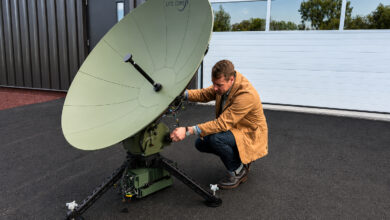
The work includes a flight-ready waveform, the signal format used to transmit information, and an in-orbit demonstration to assess its performance.
Earlier this year, the company received a multimillion-dollar US government contract for a year-long effort to develop an AI platform for military spectrum operations.
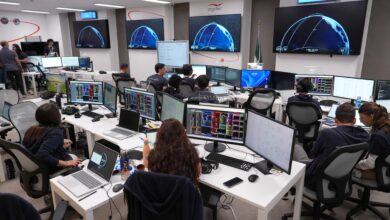
The project is intended to support operators with autonomous mission planning, execution, data management, and intelligence analysis.