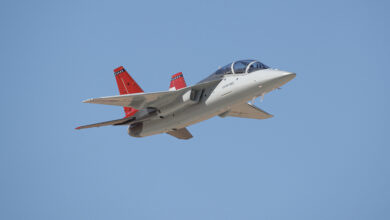

Shield AI is advancing its X-BAT fighter toward planned production in 2029 after naming two sites that will support the aircraft’s production, testing, and sustainment.
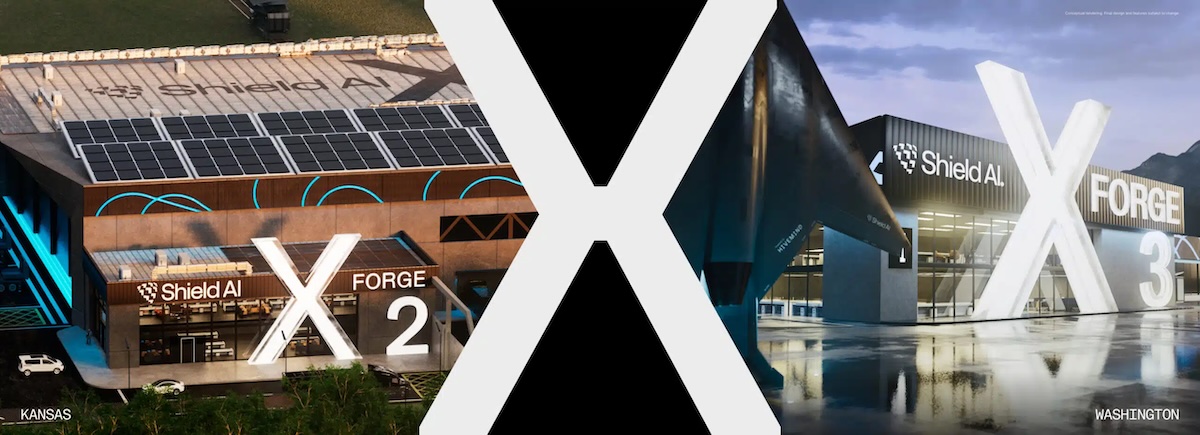
X-BAT flight testing and sustainment activities will be carried out at X-Forge 2 at Newton City-County Airport in Kansas. Meanwhile, the vertical takeoff and landing (VTOL) aircraft will be produced at X-Forge 3 in Des Moines, Washington.
With X-Forge 1 in Frisco, Texas, serving as the prototyping site, the three facilities are set to support X-BAT from development and production through delivery and fleet sustainment.
Kansas and Washington
Shield AI’s Newton site will handle the X-BAT’s production acceptance testing, as well as maintenance, repair, and overhaul services. Customers can also conduct their own acceptance flights there.
The company currently leases hangar and office space and approximately 10 acres (4 hectares) at Newton City/County Airport. Shield AI committed to the site in 2025 and is working with the City of Newton and Harvey County to expand its footprint and develop a larger hangar.
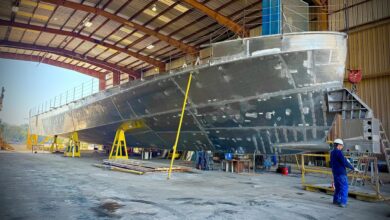
Meanwhile, the California firm is already underway with site construction in Des Moines.
Shield AI selected Des Moines, Washington, because King County has “more than 45,000 aerospace workers at more than 400 companies,” while Washington has more than 1,500 suppliers.
In addition, “both these regions were building airplanes before Shield AI existed, and we went to them for that reason,” said the company’s Senior VP of Aircraft Armor Harris.
The latest facilities are projected to support about 9,800 jobs by the early 2030s and add roughly $78 billion to the Newton and Seattle economies through 2046, according to Shield AI.
X-BAT
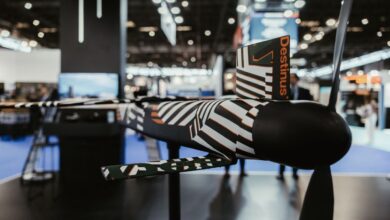
Shield AI unveiled the X-BAT in October 2025 and plans to make the platform reach full-rate production by the early 2030s.
As a VTOL aircraft, the AI-piloted fighter can launch from ships and other unpaved sites and reach an objective combat radius of 1,000 nautical miles (1,151 miles/1,852 kilometers).
The X-BAT will feature internal weapons bays comparable in size to those of the F-35 and carry weapons in the 2,000-pound (907-kilogram) class. It will also support electronic warfare and intelligence, surveillance, and reconnaissance payloads.
It will be powered by GE Aerospace’s F110 engine and use the company’s Hivemind autonomy software, which is designed to enable operations without GPS or communication links.