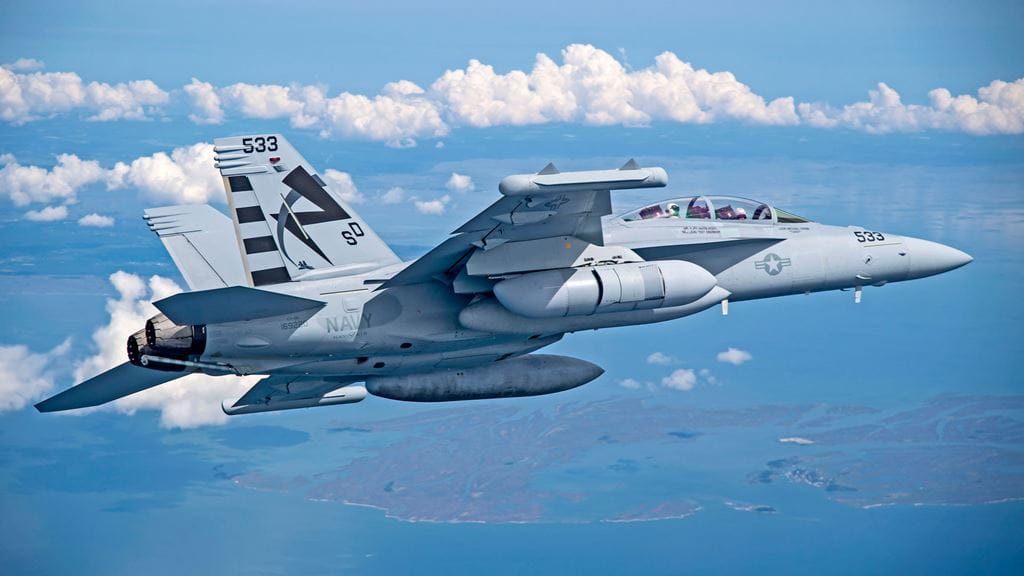

Marotta Controls has secured two contracts to provide components and engineering support for the US Navy’s Next Generation Jammer-Low Band (NGJ-LB), an airborne electronic warfare system being developed for the EA-18G Growler.
The New Jersey-based company said it will support the program through a subcontract with CFD Research and a separate direct award from L3Harris Technologies, the NGJ-LB prime contractor.
Under the CFD Research subcontract, Marotta will provide technology for the Turbine Speed Control System used in the ram air turbine power-generation assembly inside the NGJ-LB pod.
“This is a proud moment for our team,” said Adit Girdhari, Marotta Controls’ vice president of business development. “Contributing to two separate subsystems on the same Navy EW platform is a real testament to Marotta’s technology development process.”
The company did not disclose the value of either award.
NGJ-LB Replaces Legacy Jamming System
The NGJ-LB is one element of the navy’s broader Next Generation Jammer family, which is intended to augment and eventually replace the AN/ALQ-99 Tactical Jamming System used by the EA-18G Growler.
The Growler, a modified F/A-18F Super Hornet, is the navy’s dedicated airborne electronic attack aircraft. Its mission includes using electronic warfare systems to disrupt, deny, or degrade adversary radar and communications.
The NGJ program is being developed in multiple frequency bands. The Low Band variant is intended to provide electronic attack capabilities against threats operating in lower-frequency portions of the electromagnetic spectrum.
In August 2024, the US Navy awarded L3Harris a $587.4-million contract for NGJ-LB engineering and manufacturing development. The five-year award covers eight operational prototype pods for fleet assessment, along with additional test assets for airworthiness and design verification.
The system is designed to use digital processing and electronically scanned array technology to support airborne electronic attack missions. It is also intended to provide an architecture that can be updated as threat systems and electronic warfare requirements change.
The navy has described the NGJ-LB as the next increment of its airborne electronic attack capability, with the system expected to support both US and Australian EA-18G fleets.
Marotta said the awards mark its entry into the airborne electronic warfare market.
“Electronic warfare is a growth area for Marotta, and the NGJ-LB program is a strong foundation to build on,” Girdhari said. “We look forward to supporting L3Harris, CFD Research, and the Navy as this system moves toward the fleet.”