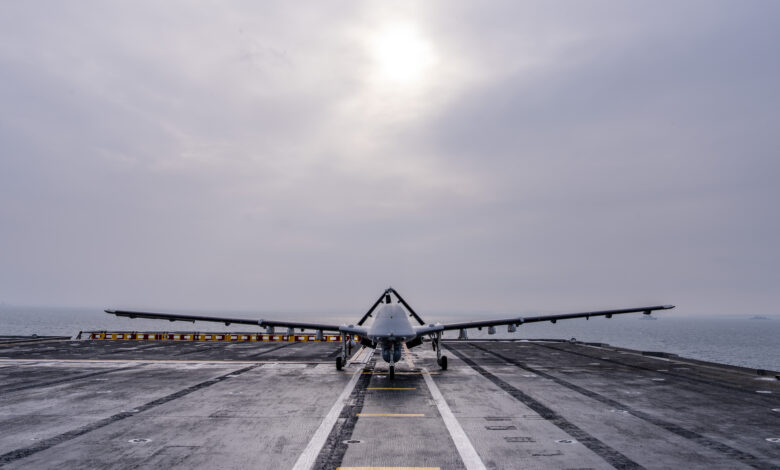

Militaries across NATO have found a comforting answer to their most uncomfortable questions. Worried about surveillance gaps over vast maritime approaches? Buy drones. Concerned about vulnerable borders or contested airspace? Add more unmanned systems.
Drones are effective and earn their place in modern arsenals. The trouble starts when they stop being one tool among many and start being treated as the answer to problems that have nothing to do with sensors and everything to do with the physical infrastructure a military needs to actually fight.
The scale of that shift is no longer subtle. European defense tech startups, most of them building drones, autonomous systems, and related software, raised roughly 600 million euros in 2021 and nearly 3.94 billion euros in 2025, a fivefold increase in four years.
Across the Atlantic, the Pentagon’s fiscal 2026 budget request created a dedicated $13.4 billion line for autonomy for the first time in its history.
This money competes for the same budgets and the same political credit as the far less exciting task of maintaining bases, ports, and depots. A drone can detect a threat. It cannot repair a bridge, restock a depot, shelter a squadron, or berth a ship.
Detection and response are different capabilities, built on different timelines, and no amount of investment in the first compensates for neglect of the second.
Three Very Different NATO Members, None Able to Drone Their Way Out of It
Start with a small, geographically exposed case: Portugal. Its Atlantic responsibilities, spanning search and rescue, counter-narcotics interdiction, and submarine cable protection across an ocean area many times the size of the country itself, are increasingly monitored by aerial and maritime drones based on the mainland.
In April 2026, Portugal became the first European country to launch a purpose-built drone carrier, the NRP D. João II, built specifically around unmanned aerial, surface, and subsea systems.
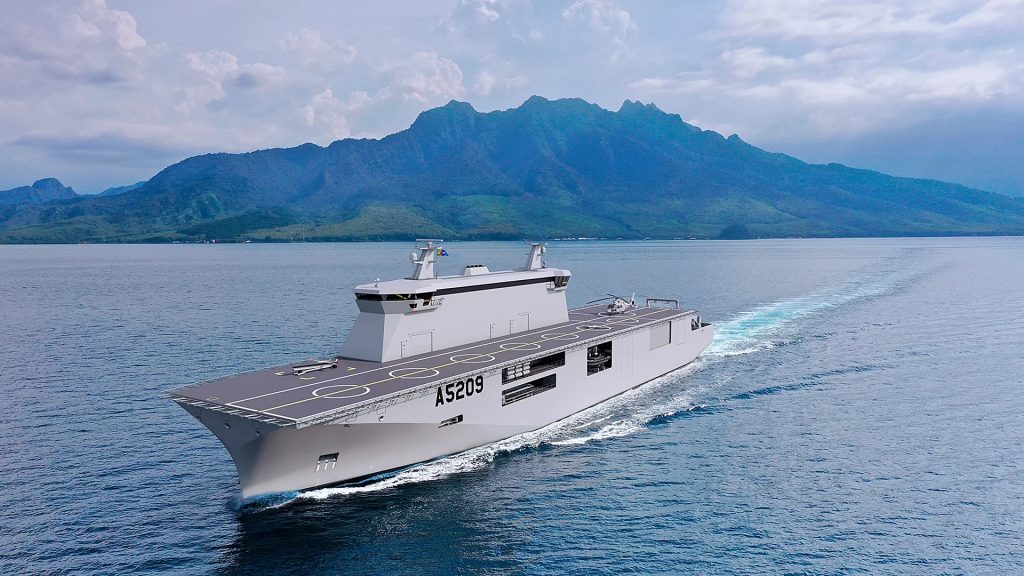
The problem is what happens after something is found. Portugal operates a single main naval base, at Alfeite on the Tagus, to support a maritime area stretching from the mainland to the Azores and Madeira.
A single base does not project security across that distance; it advertises the absence of it, leaving the islands structurally under-defended and dependent on assets that must first cross open ocean before they can act.
That gap became concrete in January 2026, when authorities intercepted a nine-tonne cocaine shipment off the Azores, a bust credited to intelligence-sharing rather than nearby naval presence, which immediately reopened calls for more long-range drones.
A drone patrolling the mid-Atlantic can flag a threat in minutes; the ship, crew, and port capable of responding may be days away.
Wider sensing has not shortened that distance: an archipelago nation with no distributed military footprint across its own islands has little real capacity to defend them against narco-trafficking or anything else.
Germany shows the opposite failure mode: not concentration, but decay. Unlike Portugal, the Bundeswehr inherited an unusually dense network of barracks, depots, and airfields from the Cold War. The problem is that having a wide footprint has not translated into having a usable one.
Germany’s own parliamentary commissioner for the armed forces put the backlog in military infrastructure renovation at roughly 67 billion euros, warning that many barracks remain in what her own report called a “disastrous state.”
By 2024, more than a third of Bundeswehr helicopters were grounded for lack of maintenance, and roughly 40 percent of barracks needed renovation or replacement outright.
Berlin is now spending heavily on new hardware, but new hardware still needs functioning runways, hangars, and depots to operate from, and those have been quietly deteriorating for decades.
The most instructive case, though, may be the one with no excuse of scarcity at all. The United States spends more on defense than the next several countries combined and leads the world in military drone development. Yet a Government Accountability Office (GAO) report released last month put the Pentagon’s deferred maintenance backlog at an estimated $285 billion, spanning barracks, runways, and other mission-critical facilities.
GAO investigators found the department has consistently funded only about 80 percent of its own maintenance targets, prioritizing new weapons programs and readiness exercises over the unglamorous work of fixing what it already owns.
If the best-funded military in the world can accumulate a backlog that size while simultaneously building out a multibillion-dollar autonomy portfolio, the problem clearly is not a shortage of money. It is a standing preference for visible capability over invisible resilience.
A Problem Both Alliances Already Recognize
None of this makes drones a bad investment. It makes them an incomplete one.
NATO’s own resilience framework, built around baseline requirements for transport, energy, and communications, and the European Union’s parallel push to harden dual-use ports and transport corridors, both already acknowledge that armed forces cannot function without the physical systems underneath them.
What neither has solved is the political incentive problem: infrastructure spending produces no ribbon-cutting moment, no export contract, and no headline capability demonstration. A squadron of drones does.
There is a second cost to this pattern that gets less attention than the budget lines.
Militaries that lean on standardized, sensor-driven systems risk losing something harder to rebuild than a barracks: the habit of improvising when the technology fails.
During Ukraine’s 2022 Kharkiv counteroffensive, junior commanders exploited gaps in Russian lines without waiting for approval from higher headquarters, a decentralized model widely credited with the operation’s success.
A force optimized entirely around detecting problems in real time is not obviously prepared for the moment its sensors go dark and someone still has to decide what to do.
Portugal, Germany, and the United States arrived at the same underlying vulnerability from three different directions: too little infrastructure, an unmaintained abundance of it, and a maintained abundance nobody bothered to fix.
The lesson for the alliance is not that any of them should buy fewer drones. It is that no amount of sensing can substitute for the unglamorous, expensive, and politically thankless work of keeping the ports, barracks, and depots underneath those sensors actually able to fight.

João Pires Cordeiro holds a Master’s in Diplomacy and International Relations from Lusófona University of Lisbon and a Bachelor’s in European Studies from the University of the Azores.
The views and opinions expressed here are those of the author and do not necessarily reflect the editorial position of The Defense Post.
The Defense Post aims to publish a wide range of high-quality opinion and analysis from a diverse array of people – do you want to send us yours? Click here to submit an op-ed.