US Air Force Tests MQ-9 Reaper Drone in Challenging Environments


The US Air Force has conducted Exercise Reaper Castillo to test the mission capabilities of the MQ-9 Reaper drone in challenging environments.
The drills involved the 65th Special Operations Squadron (SOS) to test dirt-strip landings, refueling, rearming, and rapid relaunches.
Above the Melrose Air Force Range in New Mexico, an MQ-9 circled the area, surveying the terrain before landing on a dirt runway.
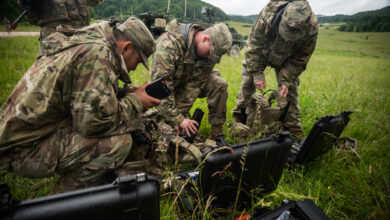
The 1st Special Operations Mission Sustainment Team secured the landing zone to enable the aircraft’s refueling and rearming.
The drone was operated remotely by a pilot and sensor operator located over 1,100 miles (1,770 kilometers) away at Hurlburt Field in Florida.
“The MQ-9 is extremely relevant in today’s fight and will be in the future as well,” said a 65th SOS MQ-9 evaluator pilot and exercise mission commander.
The drone “allows us to go places and do things that we cannot risk sending manned aircraft – such as high-threat environments.”
The overall aim of the exercise is to create “a lighter, leaner, and more agile force,” stated the US Air Force in a press release.
MQ-9 Reaper
The MQ-9 Reaper, developed by General Atomics, is designed to perform diverse missions, from intelligence and surveillance to close air support, precision strikes, and combat search and rescue.
The drone has a wingspan of 66 feet (20 meters), a payload capacity of 3,750 pounds (1,701 kilograms), and a maximum speed of 240 knots (276 miles/444 kilometers per hour).
The MQ-9 carries a Multi-Spectral Targeting System for engaging targets, including an infrared sensor, shortwave infrared camera, and laser designator.
The aircraft can integrate a range of weapons, such as AGM-114 Hellfire missiles, GBU-12 Paveway II bombs, GBU-38 Joint Direct Attack Munitions, and GBU-49 Enhanced Paveway II bombs.
The drone is supported by a system that includes a ground control station and a Predator Primary Satellite Link.
The system is operated by a crew consisting of a pilot for mission control and an enlisted aircrew member for sensor operations and weapons guidance.